
My love of theatre can probably be traced back to Year 5 when I played Macbeth in front of a whole-school audience, the most dramatic moment coming as I thrusted
my plastic devil’s fork into James Forrester’s bollocks. The painful scream which echoed around the dinner/ PE/ assembly hall marked not only the death of
King Duncan but also my short-lived aspirations of becoming a thespian.
Fast-forward 15 years (circa 2005)...
I didn’t take the decision to become a teacher
lightly. Before starting Initial Teacher Training I spent a couple of years as
a youth worker and school-based learning mentor, dipping my toe in the water
before making the pedagogical plunge. It was during these years that I realised
teaching was indeed for me. There are, I guess, tenuous similarities between
acting and teaching; the classroom a stage, the lesson a performance and the
pupils making up the audience. Though, admittedly, I am yet to receive a standing ovation for my endeavours. That aside, teaching
is also very different from acting. For example, you have to respond in
real-time to your audience, there is a great deal of ad-libbing and there is certainly no curtain call. Teaching is so much more than a script to be delivered; it involves human interaction which, from my experience, rarely goes as plans. Which is one of the many joys of teaching.
And yet, there are some people in education who argue in favour of
fully-scripted lessons. Yes, like one would expect an actor to deliver. For
clarification, scripted lessons are not merely detailed lesson plans but rather
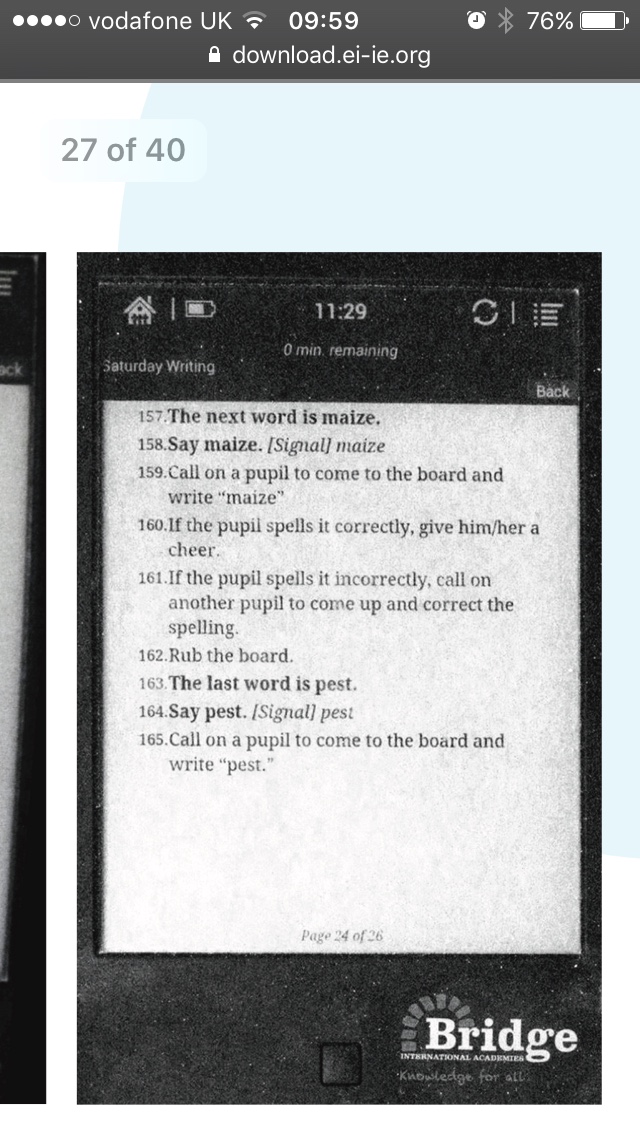
step-by-step guides for content delivery. Below is an example from Bridge International Academies (BIA) whose schools educational model has been heavily criticised for using unqualified teachers and unsanitary working conditions. What's more worrying is that Lord Nash, the schools minister, recently invited representatives of BIA for talks regarding this low-cost model of teaching.


Supporters would argue that they are a way of 'teacher-proofing' lessons and ensure that learning becomes more efficient and effective. However, I believe scripted lessons go against what teaching is (an art/ craft) and actually reduces learning to a robotic transmission of knowledge from adult to child. Which, in light of a some reductive educational discourse, should come as little surprise. For me, scripted lessons are but another step towards the automation of teaching. Something I believe is worth fighting against.

Supporters would argue that they are a way of 'teacher-proofing' lessons and ensure that learning becomes more efficient and effective. However, I believe scripted lessons go against what teaching is (an art/ craft) and actually reduces learning to a robotic transmission of knowledge from adult to child. Which, in light of a some reductive educational discourse, should come as little surprise. For me, scripted lessons are but another step towards the automation of teaching. Something I believe is worth fighting against.
Although scripted lessons are still largely uncommon in the United Kingdom,
there has been an increase in scripted curricula in the States following the introduction of
the No Child Left Behind agenda, resulting in a huge growth in commercialised
lessons and programmes. Worryingly, as we have seen with the introduction of Chartered
Schools and No Excuses behaviour policies, what happens in schools in America often finds its way across the pond. In fact, a recent Secret Teacher article highlighted how scripted lessons had been introduced to a MAT with experienced teachers being told to 'stick to the script'. This concerns me for number of reasons:
- Scripted lessons de-professionalises teaching. You don’t need a qualified teacher to deliver a script. You just need someone who can read from a piece of paper or a tablet. Not only that but they are an attack on practitioner creativity and autonomy. It eliminates the possibilities of using dialogic teaching which has been proven to enhance learning.
- Children deserve better. I say that as both a teacher and a parent. I want my children to be taught by someone who has a passion for teaching and learning and not some sort of iTeacher reading mechanically from a pre-paid script.
- This is yet another example of inviting market forces into the educational landscape. There is a lot of money to be made out of scripted curricula. I’ve written quite an extensive piece on how neoliberalism permeates every aspect of educational policy and practice in the UK, this is another nail in the coffin for public education.
Yes, I know these views are shaped by my own biases, however, some
of the research around scripted lessons hardly fills one with a great deal of
confidence. In a ten year study of effective reading instruction, Allington
(2002) concluded that there are no ‘proven’ scripted programmes and actually the most
effective schools are those that invested time and money into developing
teachers’ expertise.
Dresser (2012, p. 83) found that scripted learning
programmes actually had both a negative impact on teachers and students and
concluded that a 'better option to scripted instruction is to prepare teachers
with the necessary knowledge, dispositions and skills to succeed'. Yes, just as
Allington (2002) discovered, schools need to train teachers properly if they
are to have a positive impact on children’s learning. Dresser (2012, p. 82)
goes on to suggest that 'scripted programs keep education and learning at a
superficial level in that they narrow opportunities for teachers and students
to be innovative'. It’s fine if you don’t believe innovation to be important in
the learning process but I actually think it’s at the heart of meaningful
education. Dresser (2012,) concludes by arguing that the drive for standardized
curricula has left many children unprepared and teachers disillusioned about
their profession.
Similarly, Parks and Bridges-Rhodes (2012) have highlighted concerns on the impact of a scripted literacy
programme on a teacher's instructional practices in maths. Such as, 'the act of following a script may encourage teachers to
interact in more automatic and less thoughtful ways with their children' (2012,
p. 321). Moreover, 'the curriculum’s highly structured scripts made it less likely
that the teacher would engage in innovative practices in mathematics, which
reduced opportunities for children in the classroom to reason and problem solve
mathematically' (2012, p. 308). Again, scripted lesson limit creativity, innovation and can actually detrimental to pupils’ learning. Thanks, but no thanks.
Finally, if we take a look at BIA's model, which seems to be favoured by the likes of Lord Nash. In a recent study (Riep and Machacek, 2016), the academy chain came under serious criticism of their scripted lessons with pedagogy being rendered automated, computerised and mechanised. Furthermore, it has been argued that scripted curricula in BIA schools is controlling, rigid and 'disables creativity and innovativeness' (Riep and Machacek, 2016p, p. 29). And also doesn't require qualified and experienced teachers.
Finally, if we take a look at BIA's model, which seems to be favoured by the likes of Lord Nash. In a recent study (Riep and Machacek, 2016), the academy chain came under serious criticism of their scripted lessons with pedagogy being rendered automated, computerised and mechanised. Furthermore, it has been argued that scripted curricula in BIA schools is controlling, rigid and 'disables creativity and innovativeness' (Riep and Machacek, 2016p, p. 29). And also doesn't require qualified and experienced teachers.
'Exemplary teaching is not a regurgitation
of a common script but is responsive to
children's needs' (Allington, 2002, p. 474). The art and craft of teaching is something
that is developed over time through experimentation, reflection and adaptation.
By suggesting it can be replaced by a script is not only insulting to teachers
but potentially detrimental to children's learning.
References:
Allington, R. (2002). 'What I've Learned about Effective Reading Instruction From a Decade of
Studying Exemplary Elementary Classroom Teachers', Phi Delta Kappa, Vol. 83, No.
10, pp. 740 - 747.
Dresser, R. (2012). 'The Impact of Scripted Literacy
Instruction on Teachers and Students', Issues in Teacher Education, Vol.
21, No. 1, pp. 71 - 87.
Parks, A. and Bridges-Rhoads, S. (2012). Overly Scripted: Exploring the
Impact of a Scripted Literacy Curriculum on a Preschool Teacher's Instructional
Practices in Mathematics, Journal of Research in Childhood Education,
Vol. 26, No. 3, pp. 308-324.
Riep, C. and Machacek, M. (2016). Schooling the Poor Profitably; The innovations and deprivations of Bridge International Academies in Uganda. Education International.
https://www.ei-ie.org/media_gallery/DOC_Final_28sept.pdf
Riep, C. and Machacek, M. (2016). Schooling the Poor Profitably; The innovations and deprivations of Bridge International Academies in Uganda. Education International.
https://www.ei-ie.org/media_gallery/DOC_Final_28sept.pdf

